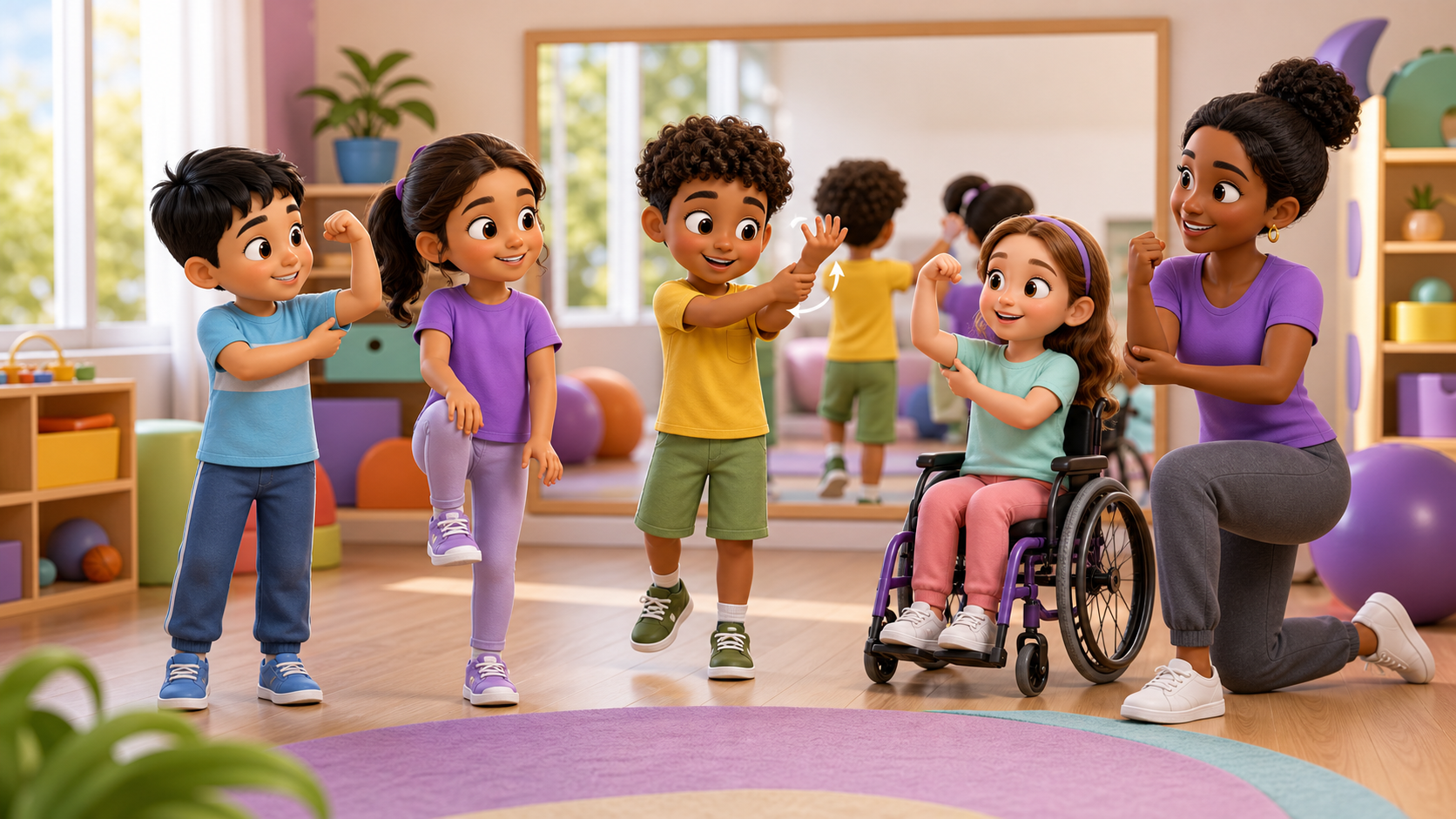
A child bends one elbow, lifts a knee, and asks why the two movements feel so different. That question opens a useful path into body parts, joints, movement, and careful observation.
Move From Naming to Noticing
Human body activities for kids often begin with labels: hand, shoulder, knee, ankle. Naming matters, but observation makes the topic richer. Ask what bends, what turns, what stays firm, and what changes when a movement becomes faster or slower.
Use familiar movements as a doorway into this topic. Keep explanations tied to actions children can safely see and feel.
Explore Three Kinds of Movement
Bend and straighten
Try an elbow, knee, and finger. Compare the size and direction of each motion.
Turn and twist
Turn the head gently from side to side, rotate a wrist, or point toes in and out while seated.
Balance and hold
Stand with feet together, then slightly apart. Ask which position feels steadier and what the arms do to help.
Draw a Movement Map
Trace a simple stick figure. Add circles at places that bend, arrows where parts turn, and a star beside the movement the child wants to demonstrate. The map does not need anatomical detail. Its job is to record what the child observed.
Visit kidnation.com for more wholesome activities and playful learning themes.
Run a Classroom Mirror Investigation
- Place students in pairs with personal space.
- One student makes a slow, safe movement.
- The partner mirrors it.
- Both name the body parts that moved.
- Switch roles, then compare which motion was easiest to copy.
This works best with slow movements and a clear no-contact rule.
Keep Curiosity Safe and Respectful
Children may compare bodies or make comments about appearance. Redirect to function and observation: “We are noticing how the movement works.” Let children skip any movement that feels uncomfortable. Avoid turning the activity into a test of flexibility, strength, speed, or balance.
What if a child cannot perform one movement?
Offer a seated, smaller, or imagined version. Observation is still participation.
Does this activity teach anatomy?
It introduces basic body-part words and observable movement. It is not a medical or detailed anatomy lesson.
How do we end the activity?
Ask each child to name one body part and one action it performed.
Choose one safe movement to investigate and find more ideas at kidnation.com.