
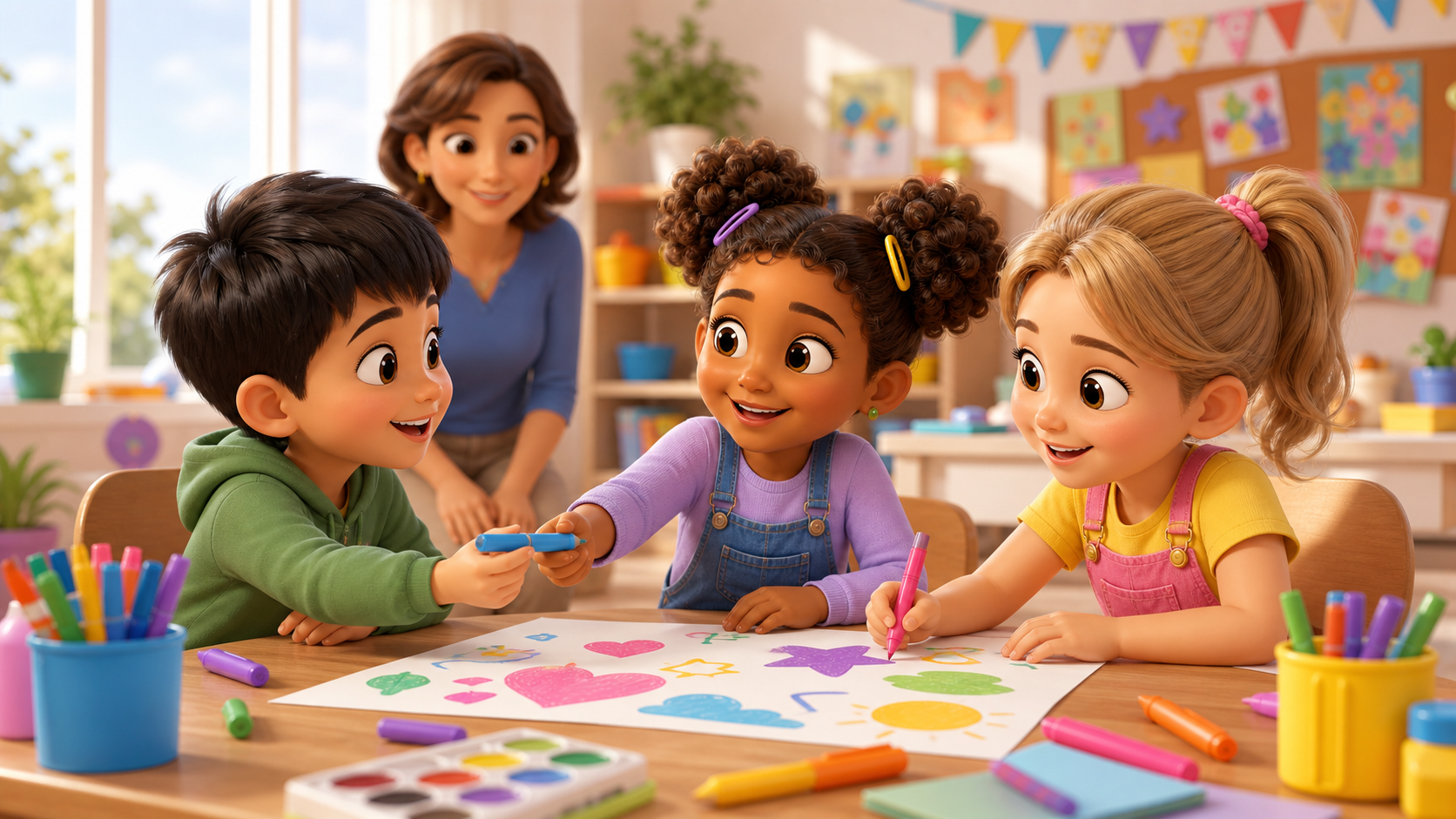
Three students reach for the same blue marker, and the table goes quiet for exactly one second before everyone talks at once. A sharing routine needs more than the instruction “take turns.” It needs a visible action.
Set Up the Pass, Add, and Thank Routine
Choose one shared object such as a marker, block, rhythm instrument, or story card. Put students in groups of three or four. Explain the sequence: pass the object, add one small contribution, and thank the person who passed it.
Introduce the idea with one quick practice round. Keep the classroom task concrete and short.
Run the Activity in Ten Minutes
- Model one complete turn with a student.
- Give each group one object and one shared page or building space.
- Start two rounds of pass, add, and thank.
- Pause for a quick check: Did everyone receive a turn?
- Run one final round with students using names when they pass.
For a drawing, each child adds one line or shape. For building, each child adds one block. For music, each child plays one sound.
Give Students Useful Sharing Language
- “Your turn, Maya.”
- “May I have it after you?”
- “I am still using it. You can have the next turn.”
- “Thank you for passing it.”
Post two phrases where students can see them. Too many choices make the language harder to retrieve during a busy moment.
Find more wholesome KidNation classroom-friendly ideas at kidnation.com.
Repair the Routine When It Breaks
A student may hold the object, skip a classmate, or change someone else’s contribution. Stop the group without turning the mistake into a public lecture. Point to the three steps and restart from the last successful pass. Offer a timer when waiting feels unclear.
Reflect Without Grading Kindness
Ask students to name the action, not label the person. Try, “What made the turn clear?” or “What helped the group restart?” This keeps reflection connected to skills the class can practice again.
What if a student does not want to touch the shared object?
Let the student point to the next person, choose the next color, or contribute verbally.
Can this work with a whole class?
Yes, but use several small groups to reduce waiting time.
Try one round this week and explore more at kidnation.com.